

Domestic
Chimney access scaffolding for a Dunblane tenement
A tower and a cantilevered roof-level platform gave a Dunblane chimney head safe, hands-free access for repair — without putting a single foot on the slates.
A three-storey red sandstone tenement in Dunblane had a chimney head that had stopped doing its job. The cement render had cracked and blown, lumps had come away, and the brickwork underneath was open to the weather. It needed rebuilding — which meant somebody had to get up there and work on it properly.
Why a ladder was never the answer
Chimney work is two-handed work. Raking out, rebuilding, rendering, flaunching and bedding pots all need both hands, a place to set tools and materials down, and enough time at height to do the job properly rather than quickly.
The chimney head here sits at the ridge of a slate roof, three storeys up. There was no safe way to reach it off a ladder, and no question of anyone walking the slates to get to it — old Scottish slate is brittle, and a foot through it turns a chimney repair into a roof repair.
There was a further complication on this elevation: overhead service lines run across it at several heights, close to where a scaffold naturally wants to go.
What we built
We put up a scaffold access tower against the rear elevation, rising the full height of the building, and built a boarded working platform at roof level out from it to surround the chimney head.
The tower has a narrow footprint — it takes up very little of the garden and leaves the ground-floor windows and door clear. Ladder access runs internally from lift to lift, with self-closing gates at each landing, so the climb is inside the structure rather than up the outside of it.
At the top, the platform is built out over the roof slope on scaffold beams and decked out around the stack, with double guardrails and toe boards. The mason can walk right round the chimney head at working height, with the platform taking the weight of tools, mortar and brick.
Crucially, the platform is carried entirely by the scaffold. Nothing bears on the slates, and nobody needs to step onto the roof covering to reach the work.
Working around the services
The overhead lines crossing the elevation set the position of the tower before anything else did. The scaffold was set out to keep safe clearance from them through its full height, including the swing of materials being passed up, and the top platform was arranged so the aerials and the lines stayed clear of the working area rather than running through it.
That is survey work, not erection work, and it happens before the first tube comes off the wagon.
A lift at the wallhead too
As well as the chimney platform, the scaffold carries a boarded lift along the wallhead, at gutter level. That gives safe access to the stone cope, the gutter line and the top courses of masonry — the parts of a traditional roof that tend to need attention at the same time as the chimney, and that are awkward to reach any other way.
Handover and inspection
The scaffold was tagged at the access point before anyone used it, confirming it had been inspected and was fit for use. It was then re-inspected at intervals of no more than seven days while it stood, and after any high wind — which, on an exposed roof-level platform in November, is not a formality.
The result
The chimney head could be cut out and rebuilt properly, from a stable platform, by someone with both hands free and their materials beside them. The roof was never walked on. The garden took a tower footprint and some sole boards. And the residents kept the use of their own front door throughout.
Chimney repairs, flaunching, pot replacement, lead work at the stack — if it is at roof level and it needs more than a glance, it needs a platform. We survey and price that kind of access across Dunblane and the wider Stirling area.
Services used on this job
From site
Photographs from the job
-
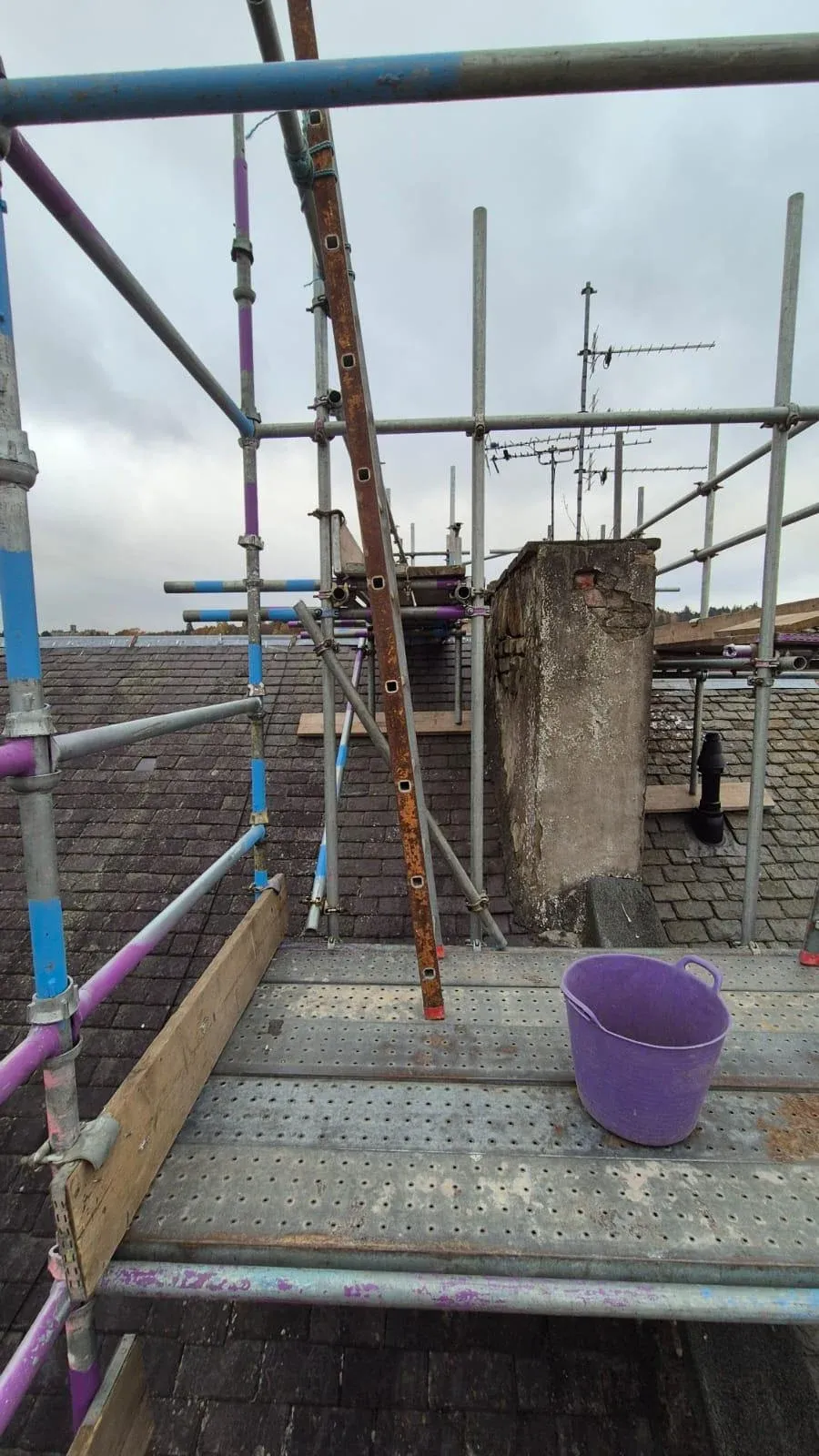
The platform wraps the chimney head, so the mason can work right round it at a comfortable height.
-
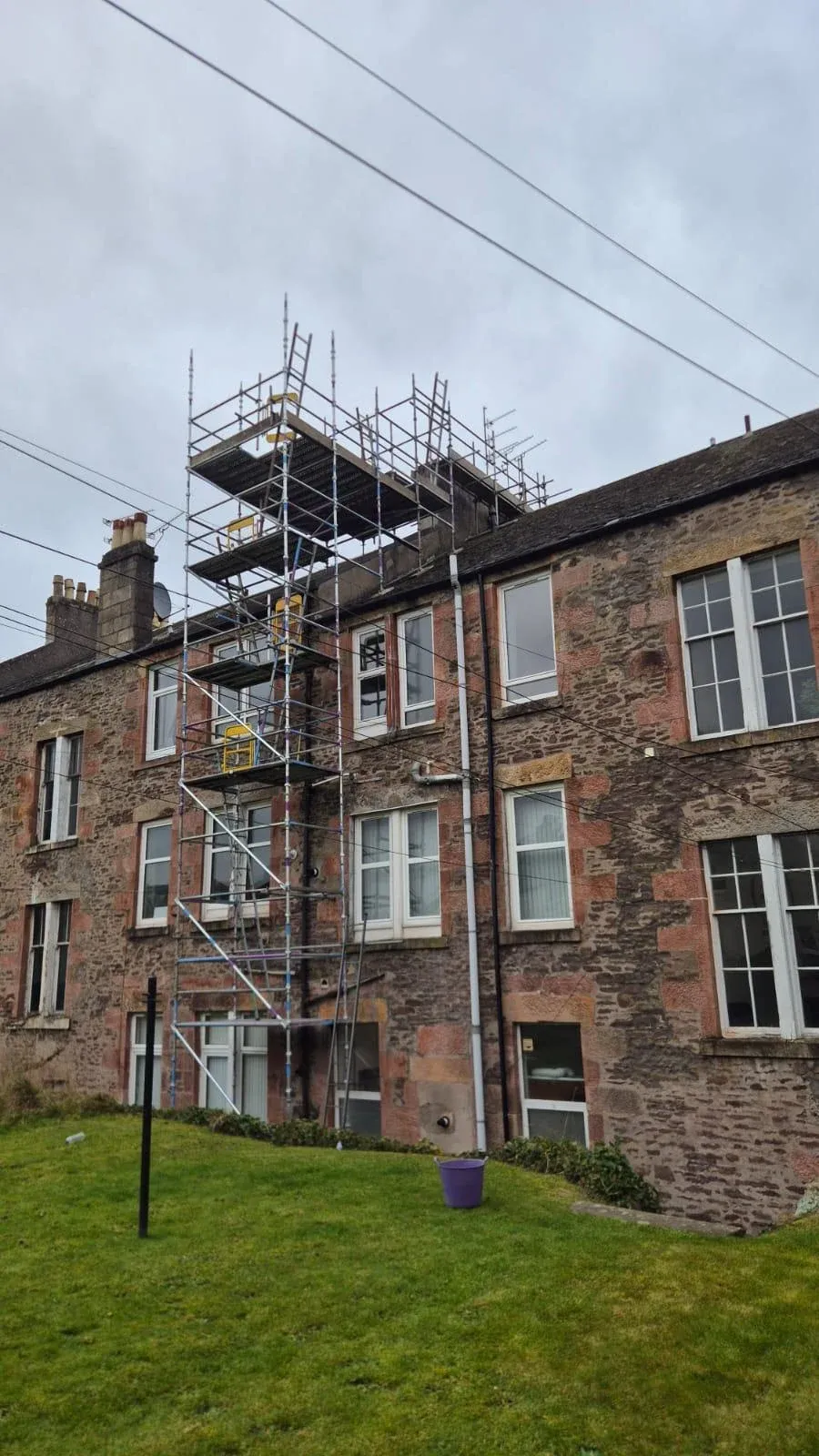
A narrow tower footprint keeps the garden and the ground-floor windows clear.
-
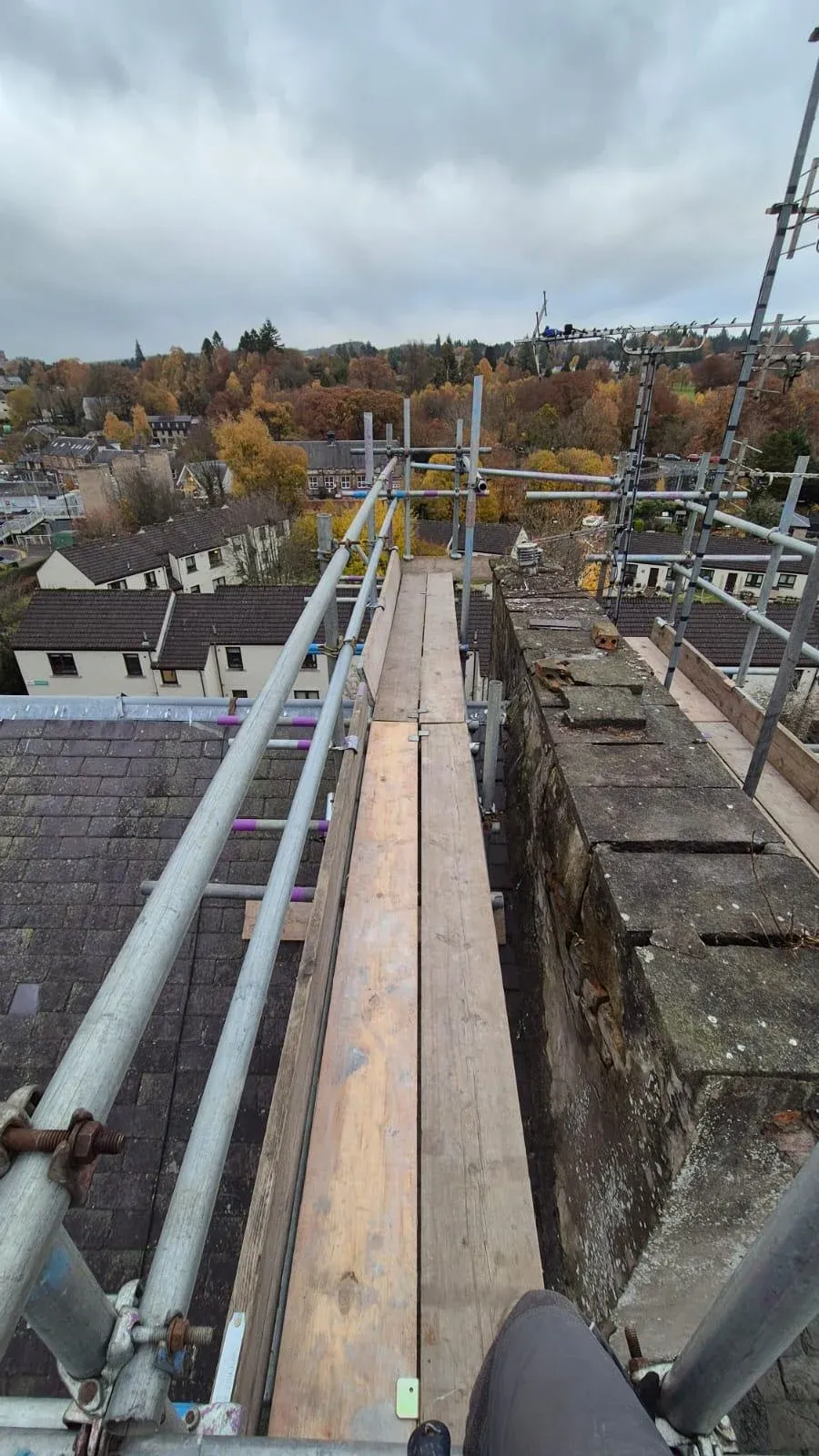
A lift at wallhead level gives safe access to the gutter line and the stone cope.
Good to know
Questions about jobs like this
Do you need scaffolding to repair a chimney?
For anything more than a quick look, yes. Chimney work means handling mortar, bricks, flaunching and sometimes pots at roof level, usually with both hands, for hours or days at a time. A ladder gives you one hand and no platform to put anything on. A proper chimney scaffold gives you a boarded platform around the stack with guardrails, somewhere to set materials down, and a safe way up and back.
What is a chimney access scaffold?
It is usually two parts. A tower or a run of scaffold carries you up the elevation to roof level, and a platform at the top is built out over or around the roof to surround the chimney head. The platform is boarded, guardrailed and toe-boarded like any other working lift, and it is supported from the scaffold rather than from the roof, so the slates carry no weight.
Will the scaffolding damage my roof or garden?
It should not. The platform is carried on the scaffold structure, not propped off the slates, so nobody needs to stand on the roof covering. On the ground, a tower has a small footprint and sits on base plates and sole boards that spread the load across grass or paving. Ties into the masonry go into joints and are made good when the scaffold comes down.
How long does chimney scaffolding take to put up?
A tower and a roof-level chimney platform on a domestic property is typically a day to erect and less to dismantle, depending on access, ground conditions and what has to be worked around. The survey matters more than the erection: overhead service lines, a narrow garden, soft ground or a shared close can all change the design before anyone lifts a tube.
More work
Other case studies
-
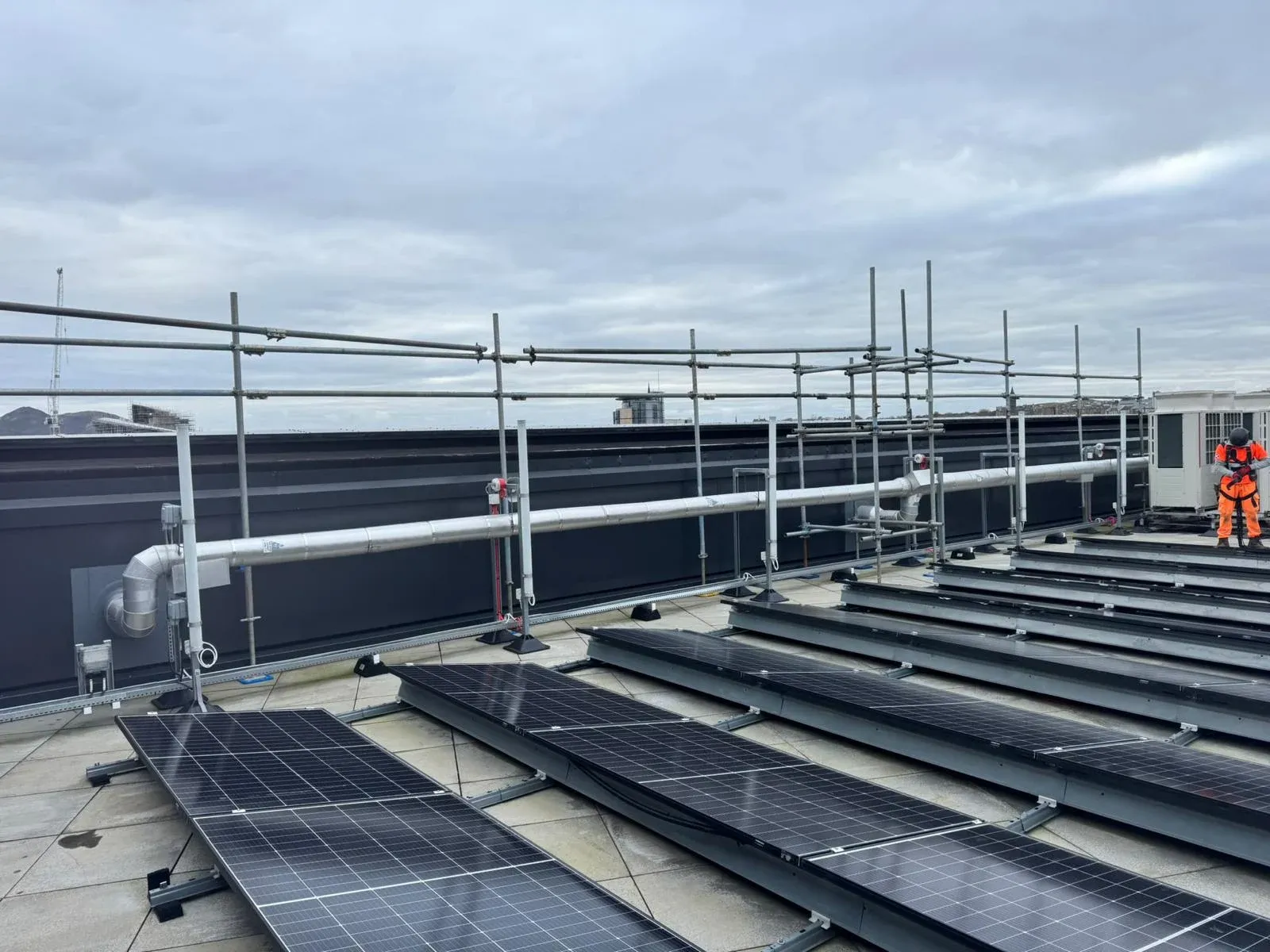
Commercial
Roof edge protection for a rooftop plant deck at Haymarket, Edinburgh
Free-standing, counterweighted roof edge protection around a live Edinburgh office roof — so engineers could work safely among a solar array, ductwork and air conditioning plant.
Read the case study -
Commercial
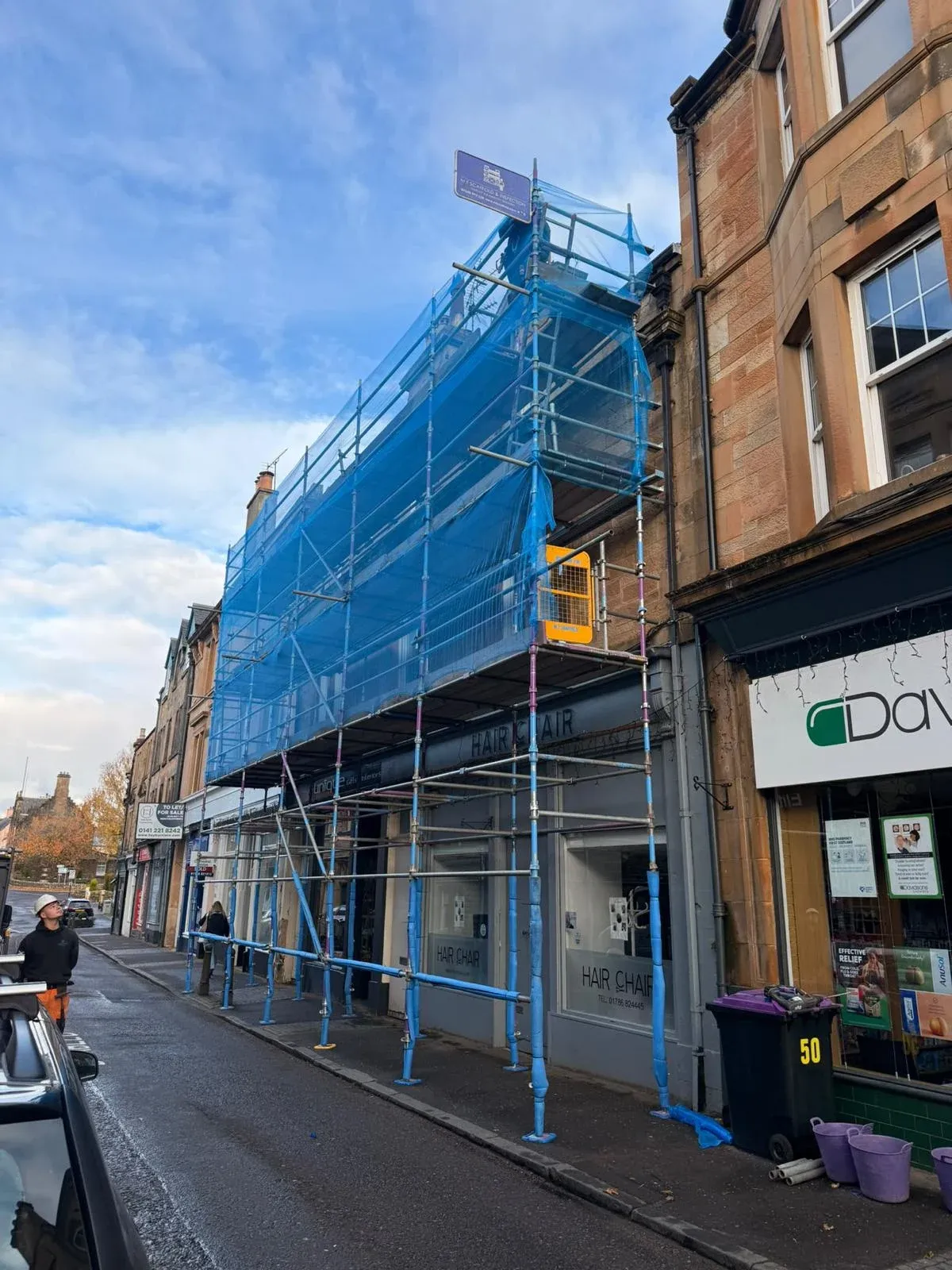
Stone refurbishment scaffolding on Dunblane High Street
Scaffolding a sandstone terrace on Dunblane High Street for stone cleaning and repointing — with the shops still trading and the pavement still open underneath.
Read the case study
Get started
Planning something similar? Talk to us
Tell us about the building, the work and the timings, and our team will come back to you with a clear, competitive price — no hidden costs.