

Commercial
Roof edge protection for a rooftop plant deck at Haymarket, Edinburgh
Free-standing, counterweighted roof edge protection around a live Edinburgh office roof — so engineers could work safely among a solar array, ductwork and air conditioning plant.
A commercial building at Haymarket in Edinburgh needed its flat roof made safe to work on. Not for one visit — for the engineers who have to go up there regularly, to a solar array, a run of insulated ductwork and a bank of air conditioning plant that all need servicing.
The problem with a busy roof
This is a roof that earns its keep. Rows of solar panels cover a good part of it, there is ductwork running the length of the parapet, and a line of air conditioning condensers sits along one edge. People need to get to all of it.
The building has a parapet, but a parapet that is there to screen plant is not the same thing as a barrier that will stop someone falling. And the working route — the clear strip between the plant and the edge — ran right along the part of the roof where a fall was possible.
The other constraint was the roof itself. On a modern build-up like this, the waterproofing is the whole point. Drilling fixings through a membrane to hold guardrail posts means creating dozens of new penetrations, each one a place water can eventually find. That was not going to happen.
What we built
We installed free-standing roof edge protection in tube and fitting, carried on counterweighted base plates.
The principle is simple: the guardrail posts stand in weighted feet that sit on the roof finish, and the weight holds the whole line upright and stable. Nothing is drilled, screwed or bolted through the roof. When the work is finished the system lifts off and the roof is exactly as it was.
The line runs the full length of the working edge with double guardrails — a top rail and an intermediate — so there is no gap large enough to fall through. At the ladder point we fitted a self-closing gate, which shuts behind whoever comes through it rather than relying on someone remembering to close it.
Setting it out around the plant
The setting-out was the part that took the thought. The guardrail line had to:
- leave a clear, usable walking route between the plant and the edge
- keep the base weights off cable trays, drainage outlets and upstands
- avoid shading the solar array or blocking a condenser intake
- stay clear of the panels and ductwork so nothing got loaded or leaned on
So the line was marked out on the roof before any materials went up, and adjusted where the plant made the obvious route impossible.
Inspection and handover
Like any temporary work at height, the system was checked and handed over before anyone used it, and it carries the same inspection regime as a scaffold: inspected before first use, at intervals of no more than seven days, and again after high winds or any alteration. On a roof in an exposed city-centre position that last point matters — a counterweighted system depends on its ballast being where it should be.
The result
The engineers have a protected working area over the whole of the live part of the roof, reached through a gate that closes itself, with a clear route between the plant and the edge. The solar array keeps generating, the air conditioning keeps running, and the roof membrane has not been touched.
If you have a flat roof with plant on it that people need to reach — solar, HVAC, lift motor rooms, telecoms — edge protection is usually the cheapest safe answer, and it does not have to damage the roof to do its job.
Services used on this job
From site
Photographs from the job
-
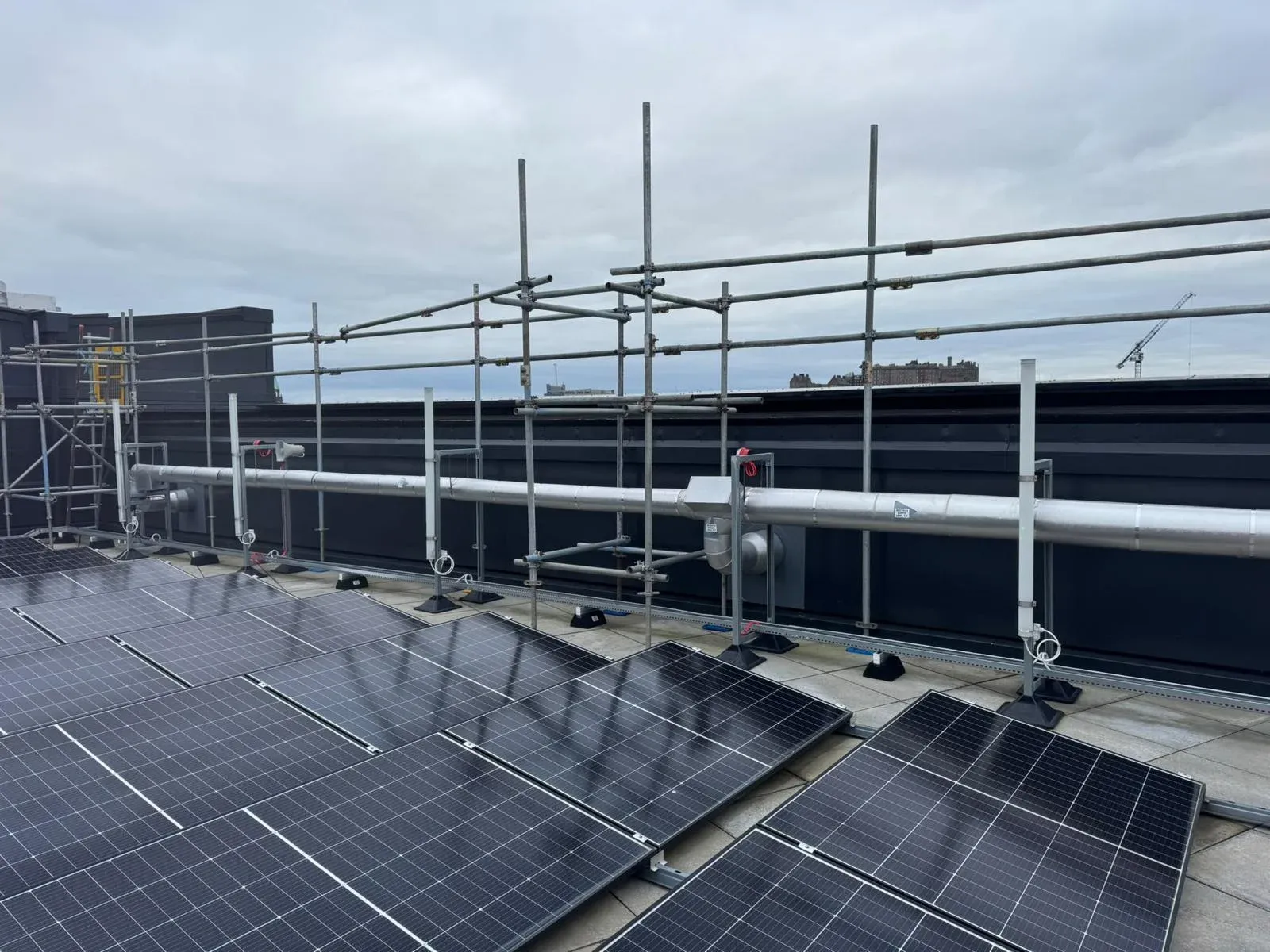
Weighted feet sit on the roof finish, so the guardrail needs no fixings through the membrane.
-
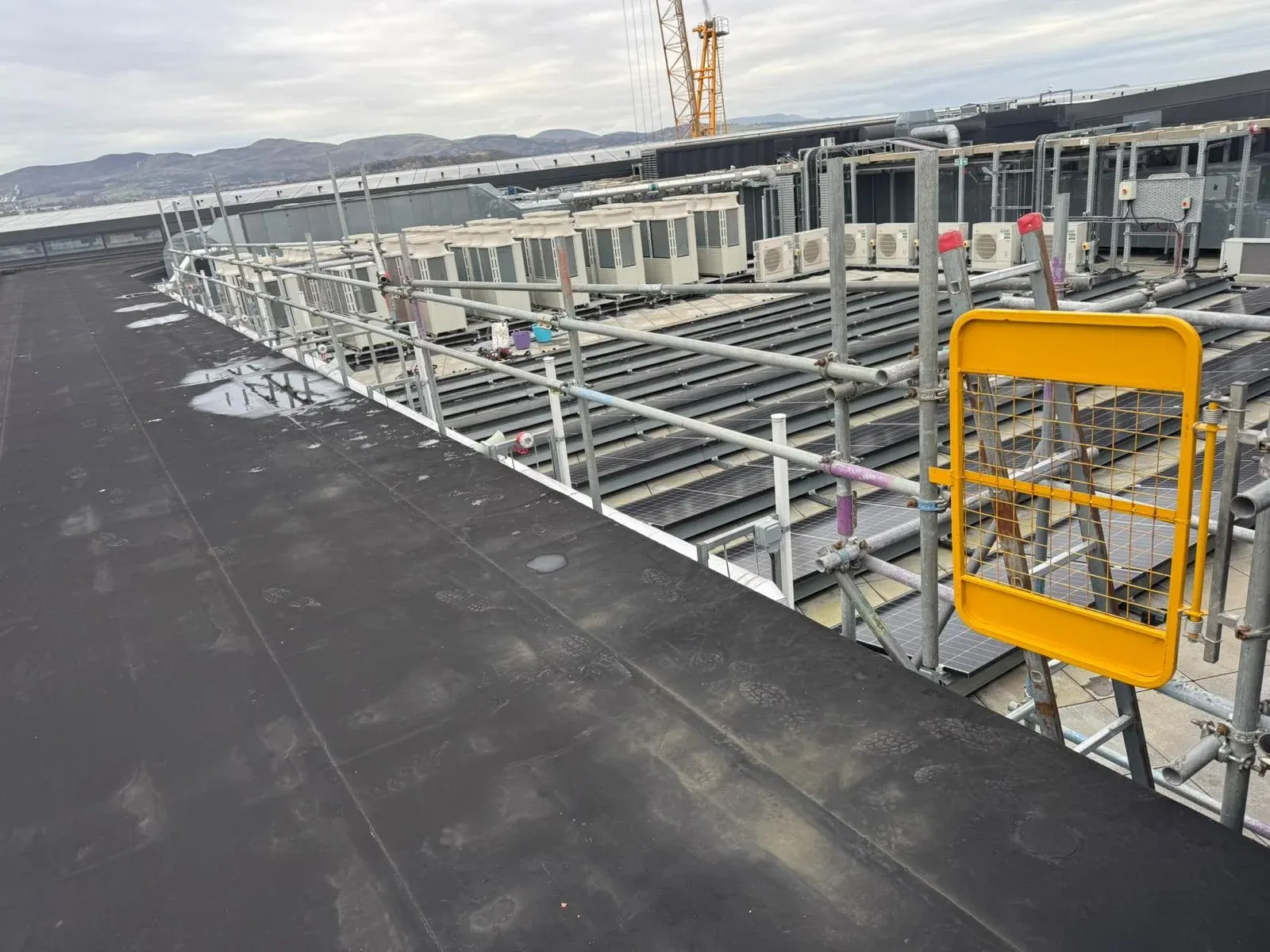
A self-closing gate at the ladder point: the only way on and off the protected area.
-
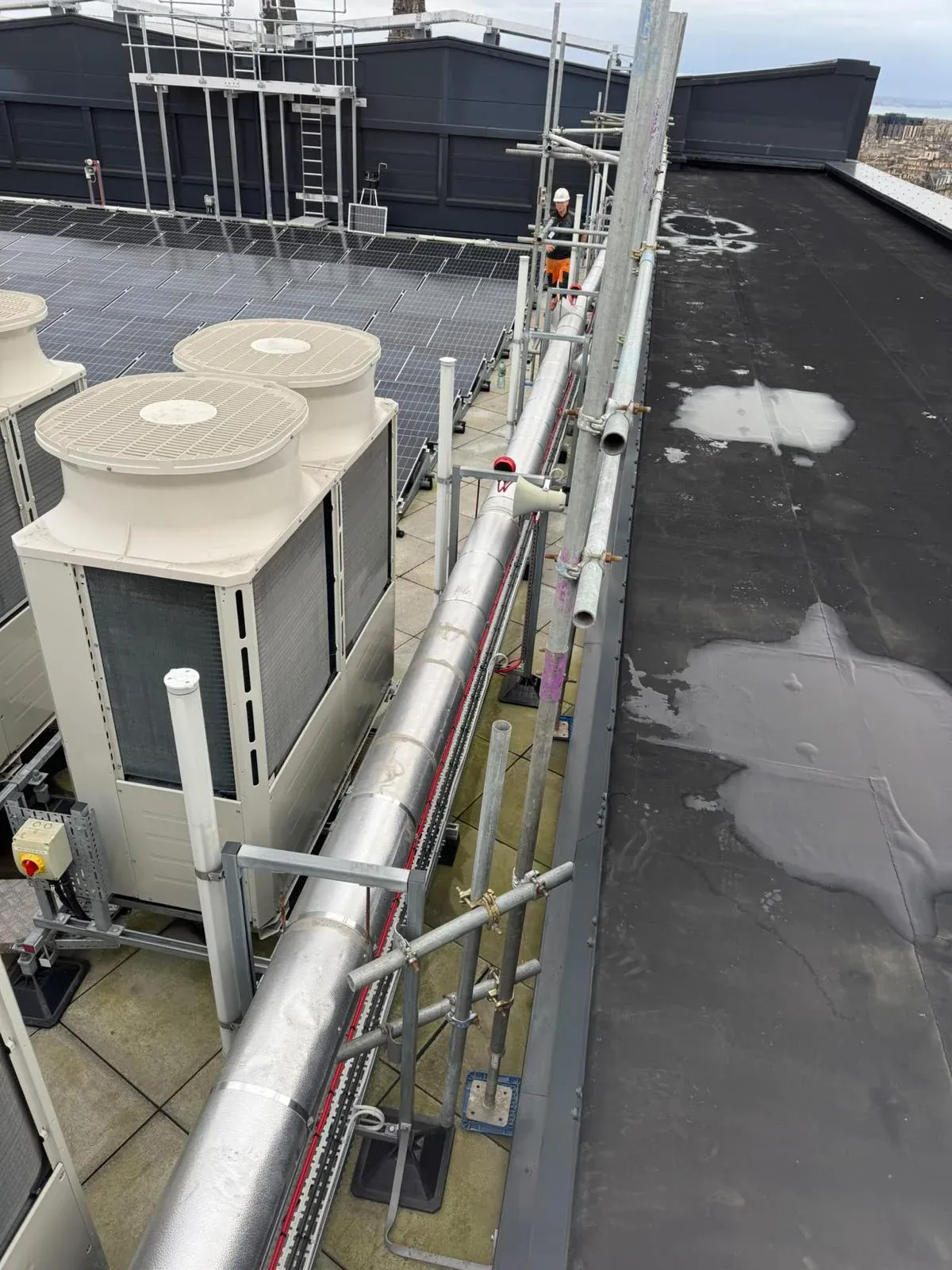
The guardrail line was set to keep a clear walking route between the plant and the edge.
Good to know
Questions about jobs like this
What is roof edge protection?
It is a guardrail system around the perimeter of a flat or low-pitch roof that stops anyone working there from falling off the edge. It is a collective measure: once it is up it protects everybody on the roof at once, without each person needing a harness and anchor point. The Work at Height Regulations 2005 put collective protection like this ahead of personal fall-arrest equipment wherever it is reasonably practicable.
Can roof edge protection be installed without drilling into the roof?
Yes, and on a modern building with a membrane or a warm roof build-up that is usually the point. A free-standing system stands on weighted base plates that sit on the roof finish and hold the guardrail upright by counterweight alone. Nothing is drilled, bolted or fixed through the waterproofing, so there is nothing to make good afterwards and no new route for water to get in.
Is edge protection needed if there is already a parapet?
It depends on the parapet. A parapet only counts as edge protection if it is high enough and strong enough to act as a barrier in its own right — as a rule of thumb that means around 950mm above the working surface, with no gap that someone could fall through. Many parapets are lower than that, or are there to hide plant rather than to stop a fall, so a guardrail is still needed behind them.
How do you work around solar panels and rooftop plant?
Carefully, and in that order. The plant is surveyed first — panels, condensers, ductwork, cable runs and anything that cannot take a load — and the guardrail line is set to leave a clear walking route between the plant and the edge. Base weights go where they will not shade a panel, block a condenser intake or sit on a cable tray, which usually means setting the line out on the roof before any materials are lifted.
Get started
Planning something similar? Talk to us
Tell us about the building, the work and the timings, and our team will come back to you with a clear, competitive price — no hidden costs.